What Makes an Object Bad? Jessi Reaves on Making Sculpture

Originally from Portland, OR, and currently based in Queens, NY, Jessi Reaves is known for a sculpture practice that utilizes readymade furniture, found objects, as well as new and recycled materials to dismantle known forms, remaking them into objects that confound preexisting notions of function and beauty.
During the opening week of her first solo museum exhibition, Jessi Reaves: process invented the mirror, the artist sat down to discuss the limits of enamel paint, landlord specials, and how material process influences her work.
Walker Art Center
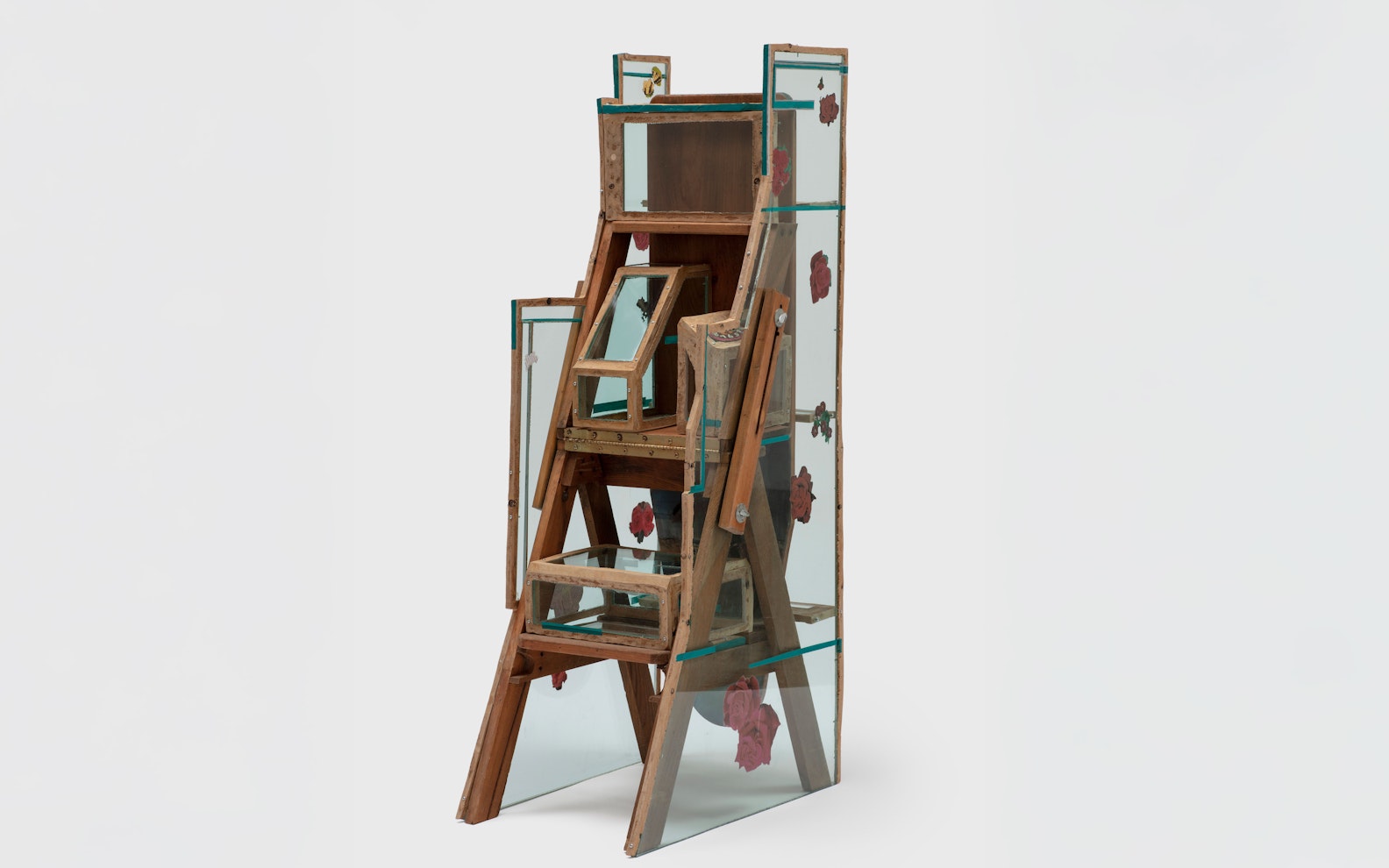
The process of making has great significance in your work. How did the making of Bad Apartment Shelf inform its creation?

Jessi Reaves
This work took a long time. Or rather, it existed in a different version in the studio for a long time. I often start these works by drawing directly on a large four-by-eight sheet of plywood with permanent marker and establishing the shape that will serve as the back of the piece, which is structurally what everything else gets attached to and what sits flat against the wall.
Thinking back, it existed in a rudimentary version—maybe even as that shape with some different pieces hanging on top of it—for six months to a year. I tend to work in bursts of energy. There was a point where I decided having it hanging in the room was the problem. I took it off the wall and cut it strategically down the middle and reduced the size of it by recombining two smaller sections. It was then that the work started to take on the form it has now.
WAC
A lot of your work begins with found objects, furniture, and other materials that you bring into the studio. Sometimes those can be recognizable—for instance, when a chair remains a chair but is repurposed—while others, particularly with Bad Apartment Shelf, might be hidden. How do you decide which pieces stay intact versus what gets modified, deconstructed, and repurposed?
JR
It is a case-by-case basis determined by whatever serves the sculpture. In the case of Bad Apartment Shelf, it had both recognizable and hidden elements. I had found a small shelf that was a curio cabinet or a small medicine-cabinet–type object. Then, as I was working on the sculpture, dimensional relationships emerged. While cutting the form down to make a reduced version of it, there was an area between the front and the back that this shelf fit in perfectly. In a way, Bad Apartment Shelf is doing both these things. It’s adding an element that is slightly more recognizable as storage, because it was a piece of found storage, but it also added structure to the piece because of how the found storage slotted in so perfectly.
Oftentimes I’ll leave things quite loosely attached on a sculpture as I work on it; it will be a single screw that holds everything together. This gives me the space to change my mind as much as I want or need to. Mostly, I try to let things be fluid until I’m really sure. Sometimes it’s the deadline that’s forcing me toward that sureness.

WAC
Bad Apartment Shelf also has elements where one material becomes a mimic of a different material. For instance, hinges are covered with blue feathers that look like painter’s tape holding it all together. It is very interesting that these materials let you see both—what they are and what they appear to be—at the same time.
JR
Often, I’ll use these flat brackets called mending plates that are commonly found in hardware stores. They can be used as a metal Band-Aid to join two pieces of wood together. It’s not a very strong way to do that, but it is a very quick way.
I sometimes think of them as the landlord’s special. What’s the cheapest, fastest way I could fix this thing? A mending plate is the perfect thing. They have a sister piece of hardware that’s a corner-mending plate. I had been thinking of making my own corner-mending plates out of feathers, which is an inherent material contradiction—the feather being this lightweight, ephemeral, fragile object, turned into a bracket. A lot of artists use painter’s tape for various reasons, and I liked that these corner-mending plates with feathers the color of painter’s tape allude to the provisional.
WAC
The title of work, Bad Apartment Shelf, has a sense of humor to it, while it also brings up ideas around what makes an object good or bad, functional or not.
JR
The title is meant to have a sense of humor as well as refer to the way the places we inhabit get categorized. The idea of a bad apartment is funny to me because everyone’s had one, but what makes a bad apartment to me is probably very different than the next person. A bad apartment is a concept that each of us defines for ourselves. But what makes it bad? What makes an object bad? Is the object misbehaving in some way or not behaving as expected?

WAC
Various materials and objects appear repeatedly throughout your work. Wicker is one that connects this earlier work, Bad Apartment Shelf, to new works, like Street lamp. How do the materials that live in your studio get repurposed into other projects?
JR
I have an area in my studio where I keep a lot of fragments to pull from. I don’t know that I’m necessarily hoping that anybody puts those pieces together, but it is just part of the nature of the way I work that materials migrate and crosspollinate between sculptures. The materials can live in the studio for a while and then take on a different life with different sculptures.
For instance, when I was first weaving wicker frames, I was trying to be really perfect about it. Then I learned from that experience, and I just stapled all the kind of spines that you weave through onto the back on the next work. I ended up more interested in the back of the woven frame than the front. It has this look of a surgical object. If you look really closely, you can see that evolution. It might be a negative evolution to most people because it’s like the process got lazier and faster, but for me that’s exciting because it results in different kind of detail.

Street lamp was another work that took a long time. If I trace the whole evolution of the object in the studio, I had started with this big chrome bar that I found on the street when I was going home one night. It was a rare time that I didn’t have my car, but I thought that this object was really something special. I decided to pause, call an Uber, and hope the driver was feeling generous enough to help me load this massive metal object into the back of the car.
I was prepared for the driver to just say flat out, “No, I’m not putting this piece of metal trash in the back of my car.” But they were nice enough to help, and we got it back to my studio. It was extremely heavy, and nothing ever happened with it for a really long time; it just sat in my studio. Just as I was ready to take it apart, we started cutting the base into smaller sections to make it easier to move around. During that process, I saw the potential for what is now the base of the sculpture. Once again, the form comes into the studio and festers for long enough that it loses any sense of being special.

With Street lamp, the top structure is a brochure rack I had in my studio. I used to keep rolls of tape on it before I reorganized the studio and it stopped being practical shop storage. That element was pulled up into that piece, and the carved wooden elements were added to it.
The carved wooden elements were in part influenced by one of my trips to Minneapolis to discuss my exhibition at the Walker. We visited the Purcell-Cutts House, which had strange floral, decorative elements of the Prairie School style. I started looking for things like that that I could use.

The carved wooden pieces I used are meant to be attached to a door or cabinetry as detail. They have this beautiful carved open space in them. That work took forever to make, and there was a lot going on in that piece. I remember looking at it and feeling like my eye couldn’t rest anywhere, which can be sort of a frustrating experience with sculpture.
It wasn’t necessarily something I was trying to work against, but it made it hard for me to feel settled in the form. This work is a rare example of when color becomes the unifying element. The paint color that I chose to use is a battleship-gray enamel paint. They only make three gray enamel paint colors. If you start to notice them, you’ll see them everywhere. It’s just a fact of enamel paint. Hardware stores aren’t allowed to mix enamel paint anymore, so they sell very limited colors that you can buy ready to go. If you are a landlord and you’re looking to paint a metal fence, you have only three grays to choose from: steel gray, battleship gray, and light gray. I decided to use this reduced gray-scale color scheme to simplify the object. That was helpful for me in terms of getting inside the form and feeling like I knew my way through the sculpture.
WAC
The work also incorporates pops of color, such as the yellow of the shade and the red of the lamp. How did you approach the use of additional color?

JR
I had gone to a lecture of the artist Dike Blair. He was talking about painting street scenes and the changing quality of streetlamps over time, from gas, to halogen to LED. It was nice to hear him, as a painter, talk about the quality of light and what he appreciates about different types of light. I wanted to refer to the idea of a streetlamp through the most simple gray-and-yellow color scheme.
WAC
Your work draws on the history of design, sometimes referencing specific designers or beginning from recognizable pieces of furniture. These references often get cannibalized or repurposed along the way. What draws you to certain references?

JR
In the case of Street lamp, the lampshade forms are something I’ve been making for a while. They’re based off Noguchi’s Akari Lamp. My general idea was to take his lampshade, which was a material innovation in both lightness and portability, and reduce it back to the original lampshade materials of welded wire with fabric. Often, I’ve been using transparent fabrics more commonly found in women’s clothing as upholstery and lampshade fabrics for almost as long as I’ve been making work in this vein.
The way I work with references from art history is that I try to trust my instinct and what I’m drawn to, but also be self-critical about taste and why I hold certain things on a pedestal, both in terms of art and design. This question allows me to see what might be there for me to work with.
With the history of design, I’m often trying to find a place that’s neither homage nor critique; instead, it is a bit of both. I might be working with a reference in a slightly devious or disrespectful way, but also in a way that holds a lot of admiration for the original idea or object.

WAC
Another work in the show, Big vanity with modesty flap, includes a non-traditional use of the Akari lampshade – in this case, as a housing for a mirror. How did that work come about?
JR
That is one of the few works in the show for which I had a particular piece fabricated. The blue plexiglass top is something I drew out on paper and had made for me. The work is really meant to be somewhere between a tabletop and a countertop. It has this strange bend that almost looks like it’s responding to a particular architectural feature, like a corner, but then it is also a free-standing object, so it has the presence of the tabletop.

Part of the origin story of this work was that I’ve always made the desk for the office of my gallery. I’ve made several experiments for Bridget Donahue Gallery, where I explored each person having their own small table versus one large table. The base of Big vanity with modesty flap is a combination of two of those that I got to bring back into the studio. In that way, it is a hybrid of several works which had a chrome materiality in common.


WAC
How did you come up with the idea of the modesty flap that allows a person to see themselves in the work or experience it without a reflective surface?
JR
It came about through working on the sculpture. The mirror is in the title of the show, so I went back and forth on whether I wanted there to be a mirror at all. While working on that sculpture, the mirror fit and made a lot of sense.
That led me to ask: If it works in this one way, what if I get there, install the show, and I don’t want to have a mirror? The modesty flap came as a result of wanting to have options, which is maybe something that’s embedded in several of the sculptures. It solves a lot of problems for a sculpture and for an installation.
This is something I began to think about after being a part of a two-person exhibition with Elizabeth Murray. She had all these different paintings that are two sections, which hang in relation to each other. I watched them struggle with installing those works because the way that the angles of these pieces interact is incredibly challenging. It has to be right. If it is off by even just a little bit, the painting looks completely wrong.
There was something that appealed to me about an artwork’s refusal to exist as one static version of itself while also not be a kinetic sculpture. The work doesn’t have to be constantly moving, or you don’t have to interact with it to experience or activate the sculpture. A sculpture can have several different ways it exists, and maybe every time you see it, you see a different version.

WAC
Is there anything else you would hope someone takes away from the work?
JR
I hope people feel empowered in terms of their own ability to make things with really simple materials, simple tools, and the objects that surround them.▪︎

Related Events
process invented the mirror: Discussing Function, Beauty, and Labor


Related Articles

Coral Dictionary: Dinawan Journals

Dyani White Hawk: Love Language Roundtable Conversation

Chang Yuchen’s Coral Dictionary

Rose Salane’s Confessions Series

Did You See the Island?: Sky Hopinka on Film and Knowledge

Humor Humanizes: Christine Sun Kim in Dialogue

Ways of Knowing Roundtable


