Walkaround Time: Photography of the Merce Cunningham Dance Company Collection
By Mary Coyne

James Klosty, Merce Cunningham Dance Company in Walkaround Time, 1968. Collection of the Walker Art Center. © James Klosty
When the stage lights go up in Walkaround Time (1968) the nine dancers are frozen, almost in mid-step as if they had been moving before the performance began. There’s something frozenly mechanical about this opening tableau, the cogs and gears of Marcel Duchamp’s The Large Glass imagery (on which Jasper Johns’ décor was based) has, as the dancers themselves, momentarily ground to a halt. This is the moment photographer James Klosty captured in his 1968 photograph of the dance, a print of which is in the Walker’s Merce Cunningham Dance Company Collection.
Cunningham was, at the making of Walkaround Time, generally against photography of his work; he was too single-mindedly focused on his next idea, a new collaboration, a new form, to consider the long-term life of his work or bear the interruption that photographers could create in rehearsal. James Klosty had begun photographing the company a year earlier in 1967. He would frequent the studio with friend and Cunningham dancer Sandra Neels and was aware of and respected Cunningham’s attitude towards photography but in his words “I just was around enough that he just used to me and stopped [objecting].”[1] For Klosty, who had not been trained as a dancer, the company offered a fascinating subject. His approach to his photography of the company was to capture the energy, the “quality of movement” not only of the dancers on stage or performance space but of the community of artists around the company. Questioning how well a static image could function as a tool towards understanding dance, Klosty’s photographs are attuned to the tensions of the body, the relationships between the dancers in a moment of rest or performance, the candid moments during rehearsals, class or travel. His 1975 book, the first ever published on Cunningham, illustrates the company’s quality of movement, across the dance space but also around the world through seven years of photographs and interviews with dancers, composers and artists. His 2014 book John Cage Was meditates of the always outgoing composer who’s energy and spirit infused the company since it’s outset in 1953, through Kosty’s photographs the lines between Cage’s practice and his involvement with the company, with each of its dancers and with his dedication to its success becomes increasingly diffused.
The photograph of the initial moment of Walkaround Time, holds this expectant moment, just before the dancers raise their arms overhead and bend forward at the waits, dropping into plié, backs curled down like wet flowers before they rise and begin to move between the inflatable décor elements, crossing the “pillows” and each other. Klosty captures the calm anticipation of the opening pose, the “time” referred to in the name of the dance which Cunningham explained as “you feed the computer information, then you have to wait while it digests. There’s some argument as to whether the computer is walking around or those who are waiting.” The concept of a set period of time, of waiting time is doubled in the image of the dancers, who, as the stage lights go down are seen waiting and repeated back as we look at an photograph, literally a temporally frozen moment. In Merce Cunnningham Klosty mediated on the near absurdity of photographing dance, that “dance’s very being is time and the essence of [dance’s] art is the linking of seconds into a language, and without time it is as meaningless as sculpture without density or poetry without words.”[2] Still, these photographs relay an important aspect of the collaborative community around the Cunningham company.
Anna Finke, who became the MCDC’s official photographer and costume designer in 2007 after working as an intern for the company, shared similar ideas about the importance placed on photography or documentation by Cunningham and his team. Her photographs were appreciated, and then requested by archivist David Vaughan and Cunningham’s press staff but only after Finke had already begun documenting out of her own initiative. Photography became more of a aspect expected of a professional company, but not something that was even found to be key by the choreographer.
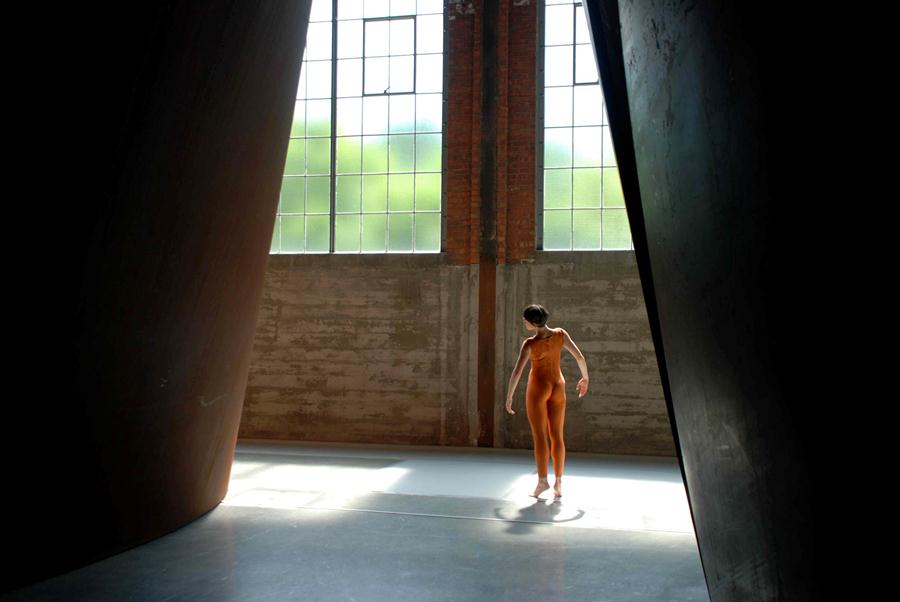
Merce Cunningham Dance Company, Serra Events, Dia: Beacon, 2008. Photo: Anna Finke
As we think through this role of photography, what it meant to the company and how it can function today, is an integral part of archiving and historicizing these dances and objects. In a recent initiative and partnership with the Walker’s new media and archives, archival photographs of the company’s performances have been added as reference images to documentation of the collection in an effort to maintain a perspective about how these costumes and objects were originally used and to maintain the spirit embodied in the original performances. Klosty and Finke, in addition to dozens of other photographers who have photographed the company over the sixty years, have both generously provided the Walker with the use of dozens of these images, now visible through the collections webpage.
In addition to the hundreds of costumes and stage décor elements that compromise the Walker’s Merce Cunningham Dance Company Collection, the Walker holds over two dozen photographic prints, collected by the company over the years. These photographs, comprised of performance stills and publicity staged studio photographs is a small sampling of the work that exists under the surface, an homage to dozens of photographers, without whom, we would know little about many of the company’s dances.
________________________________________________________
[1] James Klosty in interview at Abigal Sebaly, August 28, 2014.
[2] James Klosty, Merce Cunningham E.P Dutton & Co., Inc. New York 1975.

