Restless Creativity: Exploding Star Orchestra
By Peter Margasak
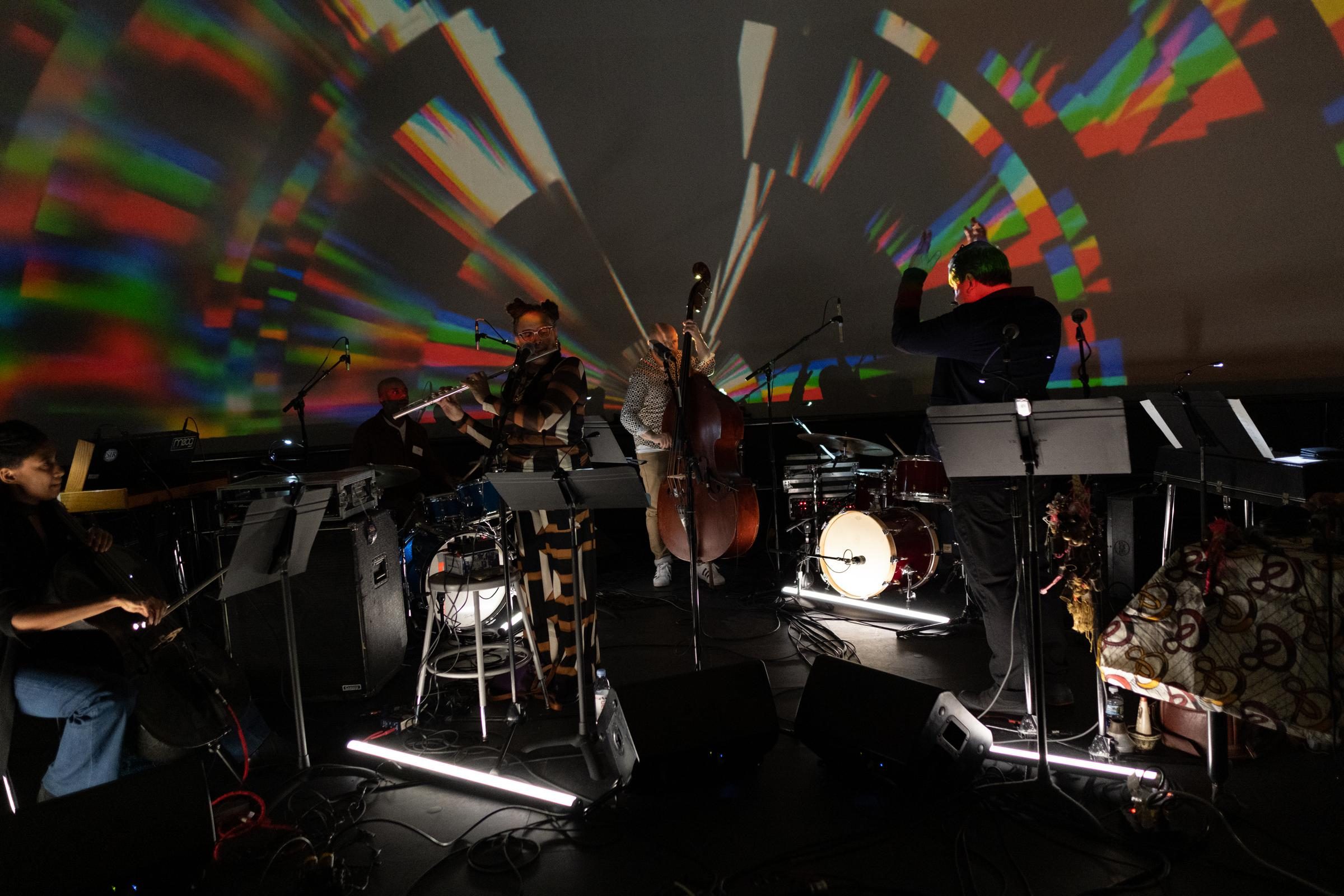
Two decades ago, trumpeter and composer Rob Mazurek assembled the first iteration of Exploding Star Orchestra, a 14-member group that neatly encapsulated the breadth of Chicago’s improvised music scene as it brought together figures from across various threads of the local avant-garde jazz community. The project has become a crucial means of expression for Mazurek’s restless creativity, presenting a widescreen vision for his celestial explorations. Sometimes the group has played material Mazurek wrote for collaborations with legends like fellow trumpeter Bill Dixon or the late reedist Pharoah Sanders, but most of the time it has given himan expansive tool to project his ideas.
While musicians from Chicago have remained central to its mission, dozens of players from around the globe have worked with the Exploding Star Orchestra (ESO)—a veritable who’s who of 21st-century jazz and improvised music. ESO is more like a family than a big band; while players may come and go, they remain part of the clan.
The lineup that Mazurek brings to the Walker Art Center spans the group’s history. Flutist Nicole Mitchell was part of the band’s first-ever performance in the summer of 2005 in Chicago’s Millennium Park, while bassist Luke Stewart is a relatively new member of the community. All the musicians are respected bandleaders and composers in their own right; among them, they include a pair of MacArthur Foundation “Genius” fellows—a vivid testimony to Mazurek’s charisma and vision as a composer.
In the leadup to ESO’s performance at the Walker, I asked Rob to reflect on the musicians joining him in Minneapolis. He shared his thoughts on what each brings to his music, followed by short portraits I wrote.

Nicole Mitchell: Nicole is the lead voice and soaring firebird of the orchestra, a constant whirlwind of sound and joy. Her melodic sensibility and rhythmic acumen often guide the direction of a given composition. Her use of electronics lately within the group creates amazing textures and puts things in a constant state of surprise. Anything seems possible with Nicole on stage.
A crucial beacon of Chicago’s improvised music scene in the 1990s and 2000s, flutist and composer Nicole Mitchell almost single-handedly carried the legacy of the founding figures of the Association for the Advance of Creative Musicians (AACM) into the 21st century. Her early project, Black Earth Ensemble, revealed her uncanny gifts as a composer of pithy, indelible melodies and as a trenchant, wildly dynamic soloist. She is a perennial winner of the annual DownBeat Critic’s Poll for her flute playing. While her small-group work remains a vital part of her practice, she has increasingly turned her focus toward epic suites, exploring her deep engagement with science fiction, particularly the writings of Octavia Butler, whose work she celebrated with her masterful Xenogenesis Suite in 2007.
Mitchell has gone on to compose numerous extended works, including Mandorla Awakening II: Emerging Worlds, EarthSeeds with poet and singer Lisa E. Harris, and, most recently, Portraits of Sonic Freedom, an acknowledgment of the importance of music, according to Mitchell, in the “role in the Black intellectual legacy and human consciousness.” That latter work premiered this summer in Charlottesville, where she’s a faculty member of the University of Virginia, extending an educational legacy with previous stops at the University of California and University of Pittsburgh.
Mitchell is a devoted collaborator, complementing her working groups with more fleeting partnerships with artists as disparate as sound poet Moor Mother, Malian kora master Ballaké Sissoko, AACM icon Anthony Braxton, British pianist Alexander Hawkins, and Black Arts Movement architect and poet Haki Madhubuti. She also maintains several crucial collective ensembles, including Artifacts with cellist Tomeka Reid and drummer Mike Reed, and Tiger Trio with pianist Myra Melford and bassist Joëlle Léandre.

Damon Locks: Damon is the voice of the orchestra, a powerful beacon of sound, whether succinct and audible or cracked, distorted, intentional, and beguiling. A sorcerer of words and electronic bliss, he often bookends compositions with his declamations of future possibility and utopian futures. He is by all accounts a supernatural dancer, constantly a locus point of positive energy, a gatekeeper of the sublime. All are welcome.
Composer and performer Damon Locks is a Chicago treasure, an acclaimed and distinctive visual artist whose work has graced many Mazurek album covers, as well as recordings by Tomeka Reid, Irreversible Entanglements, and Makaya McCraven. But music has always been an equal passion, starting with his time as the frontman in the Chicago post-punk band Trenchmouth, with future comedy actor Fred Armisen on drums.
While the punk ethos continues to animate his work, since the demise of his first band Locks has consistently expanded his stylistic interests, first through the shapeshifting trio The Eternals, which drew heavily from the rhythmic-sonic alchemy of dub.
In 2014 he began teaching art to inmates at the Stateville Correctional Center in Chicago, an endeavor that led to a crucial sociopolitical awakening. Within a few years he formed the Black Monument Ensemble, a hybrid of Black gospel, dance, and groove-oriented soundscapes. His distinctive hectoring vocal style yielded the microphone to an agile choir, as his sensibilities opened up to engage with a fuller portrait of Black music. As Mazurek notes, Locks has long been the voice of ESO, crafting hypnotic texts somewhere between church sermons and protest oratory.
His interest in improvisation—whether using voice or samples—has led to duo projects with the iconic Chicago free-jazz reedist Ken Vandermark as well as Mazurek, who together released the acclaimed New Future City Radio in 2023. He not only contributes fiery grandiloquence to ESO performances, but he also provides electronics and a captivating stage presence, translating the music’s deep rhythmic thrust through his sui generis body movement. His texts translate Mazurek’s astronomical visions with intense chant-like phraseology.

Tomeka Reid: Tomeka often doubles bass lines to direct a more powerful bottom. Her lyrical and intense way of projecting sound pushes and pulls the time into fervent bursts of energy and has the ability to steer a given solo in multiple directions at once. Anything becomes possible and out of this everything comes a singularity that pushes past known universes of sound into something entirely original and new. The cello becomes the stage floor, becomes the earth, becomes the sky, is all encompassing.
Cellist Tomeka Reid, a 2022 MacArthur Foundation fellow, has become one of the most celebrated and in-demand figures in jazz and improvised music; yet her abiding sense of loyalty and continuing Chicago ties have made her an important part of ESO in recent years. She first emerged as a member of Nicole Mitchell’s Black Earth Ensemble in 2002, rapidly becoming a member in a wide variety of Chicago ensembles thanks to her innate musicality and ensemble-first mindset.
As Mazurek notes, she often doubles bass lines in the group, reflecting her deep ardor and skill at laying down vamps and backgrounds to give her fellow ensemble members something to build their improvisations upon. But that selflessness shouldn’t be confused with meekness: by the 2010s Reid had emerged as a major figure, whether forming a close alliance with multi-instrumentalist Roscoe Mitchell, both in his own bands and as a member of the revitalized Art Ensemble of Chicago, or working with Anthony Braxton.
She’s scored film music, including her charming soundtrack for the 2014 documentary Hairy Who & the Chicago Imagistsas well as the 2023 art documentary Westermann: Memorial to the Idea of Man If He Was an Idea. In 2015 she released the debut album from her stellar quartet with guitarist Mary Halvorson, drummer Tomas Fujiwara, and bassist Jason Roebke which continues to be the primary vehicle for her sharp writing. But she’s continued to work in a wide variety of collective ensembles, whether Hear in Now, a string trio with Mazz Swift and Silvia Bolognesi, and the AACM-oriented collective Artifacts.
She’s a member of an exciting trio with pianist Craig Taborn and drummer Ches Smith, while frequently performing and working with musicians as disparate as trumpeter Taylor Ho Bynum, British pianist Alexander Hawkins, Swedish vocalist Sofia Jernberg, reedist Dave Rempis, and guitarist Joe Morris. The original cellist in the late Jaimie Branch’s Fly or Die, she’s also a member of working groups led by Germany-based saxophonist Angelika Niescier and pianist Myra Melford.

Mikel Patrick Avery: Mikel has the innate ability to play just what is needed at the right time, with a subdued but powerful energy that creates its own vacuum of brilliant wave form. When he decides to really light it up, it’s as if the earth has cracked open and waves of super sunshine burst from the center. Weaving light from darkness and darkness from light, the spectrum is endless and full even when silent.
While he plays drums in ESO, Mikel Patrick Avery is a true multimedia artist—a filmmaker, photographer, and conceptualist—who refuses to limit his work to any single style or approach. Like many others, he was drawn to music through skateboard videos, and he’s long revealed a deeply instinctual autodidacticism in the various threads of his artistic output.
Before relocating to Philadelphia in 2021, he had quietly become a ubiquitous presence on the Chicago jazz scene, working with the likes of bassists Joe Policastro and Matt Lux, and pianist Paul Giallorenzo, but he was also involved in the underground rock scene, playing with folk-rock guitarists Ryley Walker and Bill MacKay. Beyond his participation in ESO, perhaps Avery is best known for his long-term involvement in two Chicago projects: Joshua Abrams’s Natural Information Society and the Black Monks of Mississippi, the musical project of artist Theaster Gates.
Avery’s playing is distinguished by clarity and a deceptive simplicity. He builds grooves from the most minimal of figures, gradually increasing complexity and thrust in a way that the listener doesn’t notice until it’s already passed by. It’s no wonder rock acts like Big Thief, Kurt Vile, and Basic have enlisted his talents.
Beyond his filmmaking and photography, Avery has also developed a lively practice designing simple electronic devices, including a highly coveted line of small-run effects pedals for guitarists and other amplified instruments. Much like Mazurek, he’s a natural connector, a highly observant assimilator, who can translate ideas between artistic mediums as naturally as drawing breath.

Chad Taylor: Like a great tailor, Chad weaves his magic polyrhythms into a maelstrom of sound and beauty. It’s so subtle at times that you don’t even realize what’s happening. Chad and I have played together for 30 years. We have a synergy that is powerful and cerebral on many levels that might not really be explainable. He’s an engine for the group. A true original in every way.
Percussionist, educator, composer, and bandleader Chad Taylor is probably Mazurek’s most steadfast creative partner, an essential colleague in many of the trumpeter’s most enduring projects: every iteration of the various Chicago Underground projects as well as ESO. The trajectory between the first Chicago Underground Duo album 12º of Freedom in 1998 through this year’s forceful Hyperglyph captures a stunning mutual evolution, with each musician telepathically linked through sound, whether tapping into ancient African traditions or embracing driving electronic elements.
Taylor began his musical career as a guitarist, which helps explain his remarkable melodic gifts; but by the late 1980s, he had switched to drums. After studying at the New School in New York, he returned to Chicago, where he quickly became a vital force, pairing with Mazurek, becoming a favorite drummer of the legendary Chicago tenor saxophonist Fred Anderson, and forming the trio Sticks & Stones with bassist Joshua Abrams and a young alto saxophonist named Matana Roberts.
By the turn of the century, Taylor had relocated to the East Coast, and while he maintained close ties to Mazurek and guitarist Jeff Parker—to say nothing of non-jazz work with Sam Prekop, and Iron & Wine—his circle of associates grew rapidly.
Over the last couple of decades, he’s been a trusted colleague of guitarist Marc Ribot, tenor saxophonist James Brandon Lewis, and bassist Eric Revis. He was the driving force behind Jaimie Branch’s Fly or Die quartet, and he’s played more fleeting roles with the likes of pianists Mara Rosenbloom and Aruán Ortiz, bass clarinetist Jason Stein, and saxophonist Avram Fefer. Taylor is a musician of inordinate grace and subtlety, and like most of his ESO counterparts he’s deeply committed to an ensemble sound rather than strutting out his own virtuosity.
He’s been judicious as a bandleader, making work only when the time feels right, such as Smoke Shifter, a marvelous new quintet album. Beginning in 2024 Taylor became the director of the prestigious jazz program at the University of Pittsburgh.

Luke Stewart: Luke started playing with the group quite recently and has taken the bass role to new levels. His propulsive playing and sound contribute not only to the low-end bliss that sometimes characterizes the orchestra, but also his fantastic melodic sense. His timing is impeccable even when stretching to various ways the music might go. It’s this stretching of the rhythm that creates the powerful bap and sway inherent in the group. Wood becomes the sky. Planets erupt and spiral into and out of vast fields of pure energy.
It makes all kinds of sense that bassist Luke Stewart has recently become part of the ESO firmament, as it’s hard to think of a more community-oriented musician. The Mississippi native moved to Washington, D.C., in 2005; while studying at American University, he became involved in multiple aspects of the local music community, hosting a local radio program and organizing underground punk and free jazz gigs.
In 2010, he formalized those endeavors by joining Capital Bop, a jazz advocacy organization launched by music journalist Giovanni Russonello. He began playing locally, but his fortunes changed when he met sound artist and poet Camae Ayewa (aka Moor Mother) in 2014, and their burgeoning connection led to the formation of Irreversible Entanglements, one of the most righteous and poetic free jazz bands of the 21st century.
Stewart’s music has radiated outward through various means of expression, including a continuing engagement with punk and noise. He’s led a wide variety of projects over the years, but since moving to New York in 2019, he’s increasingly become a vital rhythmic engine in numerous jazz and improvised groups, including his own multifarious Silt Trio with saxophonist Brian Settles and alternating drummers Chad Taylor and Trae Crudup.
He’s worked as a sideman for James Brandon Lewis, Anthony Pirog, William Hooker, and, more recently, the current quartet led by veteran reedist David Murray. He’s an outspoken political activist who backs up his oratory with action, as an organizer and artist. He’s a commanding bassist of deep physicality, whether adding propulsion on double bass or needling noise and ferocity with an electric bass, always with a radar-like read on the action occurring around him.

Craig Taborn: Craig’s virtuosity and openness to this music create quite a simple but complex situation. I have two pianos and a vibraphone in the group in order to have the capacity to interweave line and harmony into a cohesive whole. This approach enables a situation where all three of these instruments, through the counterpoint and structure of the compositions, allow the three to become one.
When solo excursions happen, a bright light emanates from the complexity in the way of concise lyricism and rhythmic and harmonic eruptions that pull at the very foundation of the structures to create new architectures within the existing architecture. Craig is a utopian light saber cutting time and space into iridescent prisms of form.
Hometown hero Craig Taborn earned a MacArthur Foundation fellowship this fall, one of the most prestigious honors in the United States. One could be forgiven for asking: What took so long? Over the last three decades, he’s become ensconced as one of improvised music’s most brilliant, versatile, and curious figures, a keyboardist who doesn’t see the lines that divide genre or school of thought.
His work is deliciously mercurial, masterfully precise, and endlessly poetic, blurring lines between where composition ends and improvisation begins, whether playing ’80s-style fusion in his recent collective Trio of Bloom or improvised solo piano odysseys. Taborn first arrived on the scene as the pianist for rising-star saxophonist James Carter, but he soon demonstrated nonchalant range by appearing on albums made by reedist Roscoe Mitchell and Detroit techno-star Carl Craig.
Taborn is a voracious listener, and the range of his projects captures that boundless enthusiasm. His solo work draws from the cadences of contemporary classical music, but can also explore a post–Cecil Taylor wanderlust. He’s adept on organ and synthesizers, and some of his projects tap into a spot between outer space and church.
His musicianship had led to a huge range of collaborations, including with saxophonists Evan Parker and Chris Potter, bassist Dave Holland, trumpeter Wadada Leo Smith, and violist Mat Maneri. He’s currently working in a trio with cellist Tomeka Reid and drummer Ches Smith, which will release its ECM debut in mid-January. He also plays with Smith alongside the fiery Danish saxophonist Mette Rasmussen in Weird of Mouth, a tempestuous testimony to his fluency in quicksilver free jazz. Taborn is a perfect fit for ESO, gamely serving the larger structural vision of Mazurek, but perpetually elevating the sound as an accompanist who never takes the easy or predictable route.

Angelica Sanchez: A single repeated note from Angelica becomes a world of sound. When this world of sound starts to open up, new worlds begin to emerge. Her harmonic sensibility when pushed to the limits creates a fabric of complexity, both inner and outer. A spiritual place where a higher elevation of tonal and cerebral bliss is possible, coupled with Craig’s piano and Victor’s vibraphone mega chords, and universes emerge. Then a concise strand of stacked fourths emerges from the din—Angelica’s sound drifting on a cloud of lightning.
If it’s not already clear, one of Mazurek’s great strengths is noticing artistic vision and understanding how to enfold it within his music. Assembling an ensemble is a crucial part of the artistic process, and the cumulative personnel that have played in ESO proves that he’s got a knack for such recognition.
He definitely had an idea how the sublime Angelica Sanchez, one of the most uncompromising, rigorously focused pianists in improvised music, could fit within the ESO sonic matrix, imagining her as part of a dense harmonic infrastructure with fellow pianist Craig Taborn and a vibraphonist, in this case, Victor Vieira-Branco.
At an ESO performance at Big Ears in 2023, their interactions were sublime, embracing their aesthetic differences but celebrating their sonic communion. As with Taborn’s work with fellow pianists Kris Davis and Vijay Iyer, Sanchez also loves to work with other pianists, especially the singular Marilyn Crispell. They made the astonishing 2020 album How to Turn the Moon, and more recently the pair reunited in Berlin for the premiere of Barry Guy’s new Double Trouble III.
The Arizona native has forged a remarkable body of work that straddles dense post-bop interrogations with daring free improvisation. But for Sanchez those aren’t polarities as much as overlapping procedures. Last year she and drummer Chad Taylor released the stunning a monster is just an animal you haven’t met yet, an improvised duo session that revealed a mutual sense of exploration unbound by approach.
Their investment in spontaneous sound-sculpting, with jagged melodic piano spasms floating over Taylor’s kit-spread configurations, was like a Calder kinetic sculpture. On the other hand, Sanchez possesses a deep sense of tradition, and the blues routinely ripples through even the most abstract phrases. For her there are no gaps, no divides, no boundaries—it’s all music.
Victor Vieira-Branco: The newest member of the orchestra. His intuitiveness and deep desire to experiment and delve deep allow him to take the conceptual energy of the compositions to new and fascinating heights. He really understands the idea behind the modularity and architectonics of the compositions and uses all this material to project his unique sound. This fascination with sound and silence and all it can do is inherent in the way he plays and lives.
Philadelphia-based vibraphonist Victor Vieira-Branco is another recent denizen of ESO. In fact, there’s a familial touch to his involvement, as the Brazil native once took lessons from fellow vibist Jason Adasiewicz, who has held down that role in the band on many occasions since its founding.
Vieira-Branco is also a fervent community figure in Philadelphia, devoted to programming shows and serving as a connector. He recently joined the superb new quintet led by ESO drummer Chad Taylor, and he’s found a different connection to Chicago by joining the new band of Chi-Town drummer Daniel Villarreal.
He contributed several beautiful tunes to Smoke Shifter, a debut album by the Taylor Quintet; but the fullest portrait of his sensibilities can be heard through his own group, Bark Culture. The trio features bassist John Moran and drummer Joey Sullivan delivering a spiky, high-energy post-bop balancing the vibraphonist’s energy-rich intensity with spacious grooves. The group will release the even better The Giant is Awkward early next year, a dynamic project featuring pianist Sam Yulsman that reveals a heightened sensitivity and grace, with increased harmonic splendor thanks to the added chordal voice. The record also marks the vibraphonist’s clear growth as a composer.▪︎

Related events

Related articles
